
Blog
Additive Masterbatch – Common Issues & Solutions
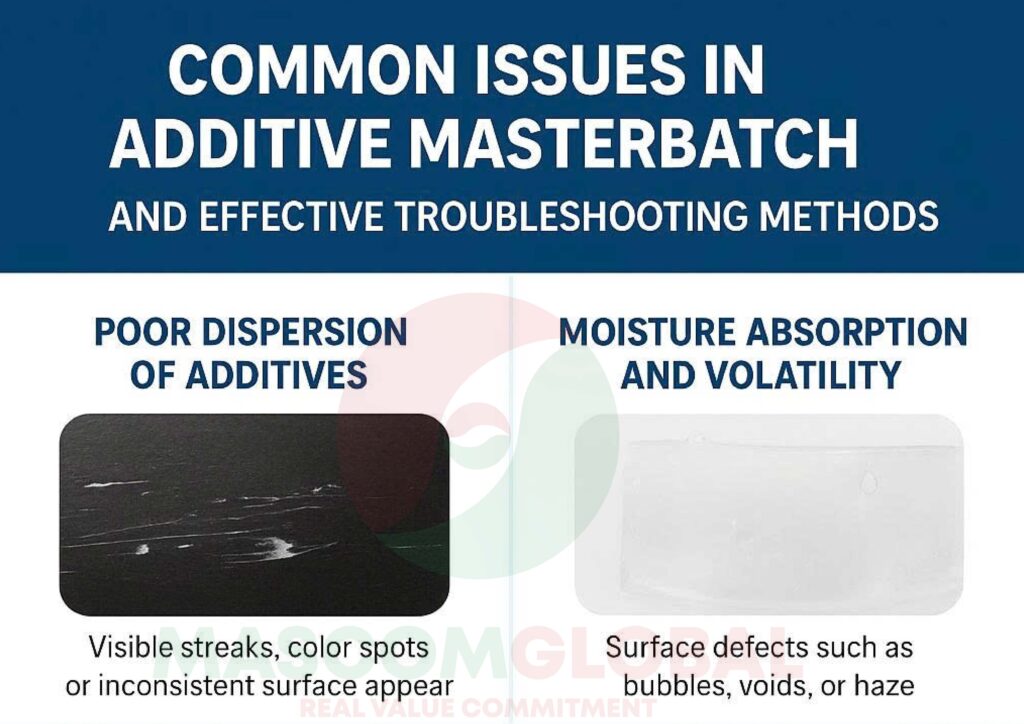
MASCOM GLOBAL – Common Issues in Additive Masterbatch and Effective Troubleshooting Methods
Additive masterbatch plays a vital role in modern polymer processing, enhancing plastic performance by providing properties such as UV resistance, flame retardancy, anti-static behavior, and thermal stability. However, during production and application, various defects can occur that affect both product quality and processing efficiency. Understanding these common issues and how to address them is crucial for ensuring consistent performance in plastic manufacturing.
1. Poor Dispersion of Additives
Problem:
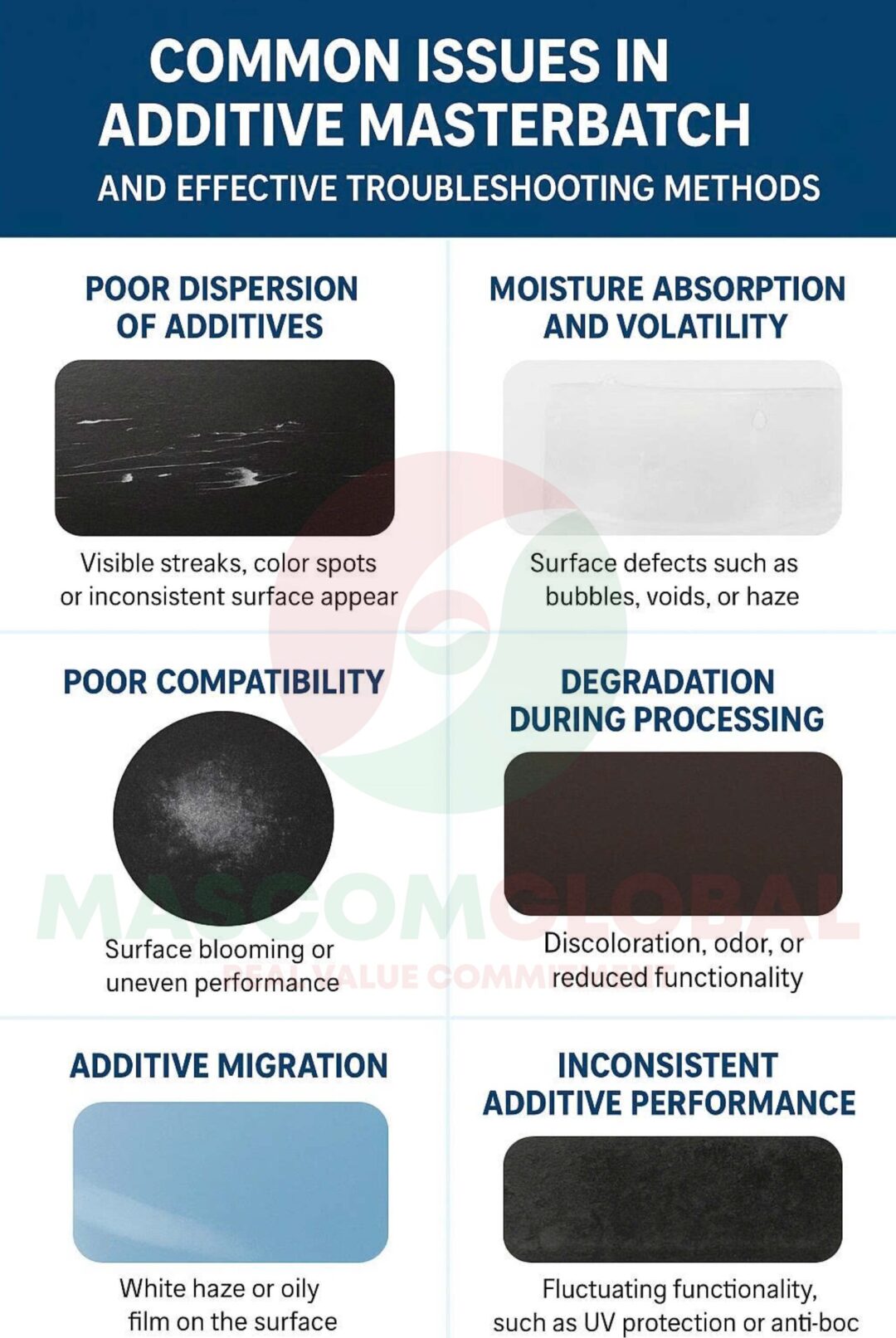
One of the most frequent issues with additive masterbatch is poor dispersion of active ingredients within the polymer matrix. This often results in visible streaks, color spots, or inconsistent surface appearance. Poor dispersion can also reduce the effectiveness of functional additives like UV stabilizers or antioxidants.
Causes:
- Incompatible carrier resin with the base polymer.
- Insufficient mixing time or inadequate screw design in extrusion.
- High additive loading beyond the carrier’s saturation limit.
Solutions:
- Choose a carrier resin that matches the polarity and melt flow index (MFI) of the target polymer.
- Optimize processing parameters such as temperature profile and screw speed to enhance shear mixing.
- Use advanced dispersing agents or coupling agents to improve compatibility between the additive and polymer.
- For critical applications, employ twin-screw extruders with appropriate mixing elements for uniform distribution.
2. Moisture Absorption and Volatility
Problem:
Moisture absorption in additive masterbatch can lead to surface defects such as bubbles, voids, or haze in the final product. In hygroscopic materials, moisture can also degrade sensitive additives like antioxidants or hinder proper polymer flow.
Causes:
- Improper drying or storage conditions.
- Use of hygroscopic carriers like nylon or PET without proper moisture control.
- Inadequate packaging that allows ambient humidity to penetrate.
Solutions:
- Pre-dry both base resin and masterbatch before processing, especially for engineering plastics.
- Use moisture-barrier packaging and store masterbatch in controlled environments.
- Introduce desiccant additives or employ vacuum venting during extrusion for moisture-sensitive formulations.
3. Poor Compatibility Between Additive and Base Polymer
Problem:
If the additive masterbatch is not fully compatible with the host polymer, phase separation or uneven additive distribution may occur. This can manifest as surface blooming, poor mechanical strength, or inconsistent performance of the final product.
Causes:
- Carrier resin mismatch with the base polymer.
- Chemical incompatibility between additive molecules and polymer chains.
- Improper additive selection or incorrect dosage levels.
Solutions:
- Match carrier resin as closely as possible to the target polymer type.
- Modify additive chemistry (e.g., using compatibilizers or coupling agents) to improve interaction.
- Conduct pilot testing to optimize the masterbatch concentration for the specific end-use polymer.
4. Degradation During Processing
Problem:
Thermal or mechanical degradation of additives during extrusion or molding can cause discoloration, odor formation, or reduced additive functionality.
Causes:
- Excessive processing temperature or residence time.
- Inadequate temperature control in the extruder zones.
- Shear overheating due to high screw speed.
Solutions:
- Optimize processing conditions — lower barrel temperatures or adjust screw configuration to reduce shear stress.
- Select heat-stabilized additive systems that can withstand processing conditions.
- Add processing stabilizers such as antioxidants or phosphites to protect the polymer-additive system.
5. Additive Migration and Surface Blooming
Problem:
Additive migration occurs when active components migrate to the surface of the final product, resulting in a white haze or oily film known as blooming. This phenomenon can compromise surface appearance, printability, or adhesion.
Causes:
- Over-concentration of additives.
- Low molecular weight or poor compatibility of additives with polymer matrix.
- Inadequate curing or cooling conditions.
Solutions:
- Optimize additive dosage to avoid oversaturation.
- Choose high-molecular-weight or polymer-bound additives to reduce mobility.
- Improve cooling cycles or post-treatment processes to lock additives within the polymer structure.
6. Inconsistent Additive Performance
Problem:
Inconsistent additive activity — such as fluctuating UV protection, anti-blocking effect, or slip performance — can occur due to uneven distribution or additive deactivation.
Causes:
- Variation in masterbatch production parameters.
- Poor additive quality or contamination.
- Aging of the masterbatch during storage.
Solutions:
- Implement strict quality control during compounding (e.g., melt flow rate, dispersion index, and active content testing).
- Ensure raw material consistency and maintain proper inventory rotation (FIFO).
- Protect masterbatch from UV exposure and high temperatures during storage.
Conclusion
Additive Masterbatch formulation and processing require a delicate balance between chemistry, compatibility, and processing conditions. By identifying and addressing issues such as poor dispersion, moisture absorption, or additive migration early, manufacturers can maintain stable production and ensure high-quality end products. Continuous monitoring, advanced formulation design, and close cooperation between polymer engineers and additive suppliers are key to achieving consistent, high-performance masterbatch solutions.
